Nov 15, 2018

Rookie of the Year: Carlton Fisk, 1972

Catcher, Boston Red Sox


Age:  24
Bats – Right, Throws – Right
Height: 6’3”    Weight: 200

Prior to 1972:
Born in Vermont and raised in Charlestown, New Hampshire, Fisk was a member of an athletically talented family who picked up the nickname “Pudge” during childhood as a result of his stocky build. A basketball star in high school, he once scored 42 points and pulled down 38 rebounds in a regional playoff game. The intensely competitive Fisk and his brothers also excelled in baseball, playing American Legion as well as high school ball. Moving on to the University of New Hampshire, where he led the freshman basketball team to an undefeated record, he was chosen by the Red Sox in the first round of the 1967 amateur draft. Determining that he could not make it to the NBA, Fisk signed with Boston. He spent 1968 with the Waterloo Hawks of the Class A Midwest League and batted .338 with 12 home runs and 34 RBIs. Moving up to Pittsfield of the Class AA Eastern League in 1969 he appeared in 97 games and hit .243 with 10 home runs and 41 RBIs, earning himself a September call-up to the Red Sox. He appeared in two games and was 0-for-5 in his first taste of major league action. He was back in the Eastern League in 1970, this time assigned to Pawtucket where he produced 12 home runs and 44 RBIs along with a .229 batting average. Fisk advanced to the Louisville Colonels of the Class AAA International League in 1971 where he refined his leadership skills and his defensive catching ability. Also he hit .263 with 10 home runs and 43 RBIs. In another late-season trial with the Red Sox Fisk hit .313 in 14 games. Slated to be Boston’s third-string catcher heading into the ’72 season, he took over the starting job when veteran Duane Josephson was injured in the early going.   

1972 Season Summary
Appeared in 131 games
C – 131, PR – 1

[Bracketed numbers indicate AL rank in Top 20]

Batting
Plate Appearances – 514
At Bats – 457
Runs – 74 [11]
Hits – 134
Doubles – 28 [6, tied with Amos Otis, Dick Allen & Graig Nettles]
Triples – 9 [1, tied with Joe Rudi]
Home Runs – 22 [7, tied with Bobby Darwin & Norm Cash]
RBI – 61
Bases on Balls – 52
Int. BB – 6
Strikeouts – 83 [14, tied with Don Buford]
Stolen Bases – 5
Caught Stealing – 2
Average - .293 [8, tied with Amos Otis]
OBP - .370 [7]
Slugging Pct. - .538 [2]
Total Bases – 246 [6, tied with Bob Oliver & George Scott]
GDP – 11
Hit by Pitches – 4 [18, tied with fifteen others]
Sac Hits – 1
Sac Flies – 0

Midseason snapshot: 3B – 6, HR – 15, RBI - 36, AVG - .310, SLG PCT - .624

---

Most hits, game – 3 on seven occasions
Longest hitting streak – 12 games
Most HR, game – one on 22 occasions
HR at home – 13
HR on road – 9
Multi-HR games – 0
Most RBIs, game – 4 vs. Texas 8/27
Pinch-hitting/running – 1 run scored

Fielding
Chances – 933
Put Outs – 846
Assists – 72
Errors – 15
DP - 10
Pct. - .984

Awards & Honors:
AL Rookie of the Year: BBWAA
All-Star
Gold Glove
4th in AL MVP voting (96 points, 29% share)


AL ROY Voting:
Carlton Fisk, Bos.: 24 of 24 votes, 100% share

---

Red Sox went 85-70 to finish second in the AL Eastern Division, a half game behind the division-winning Detroit Tigers while leading the league in runs scored (640), doubles (229), triples (34), slugging (.376), and total bases (1958). Due to a players’ strike in April that delayed the start of the season and caused 86 games to be cancelled,  teams played an unequal number of games, and the Red Sox came up a half-game short of winning their division despite a second-half surge that propelled them past the Orioles and Yankees and was largely fueled by the play of Fisk and RHP Luis Tiant.

Aftermath of ‘72:
Fisk followed up with another All-Star season in 1973, although his average dropped to .246 and his home runs rose to 26 and RBIs to 71. He also became known for his aggressiveness that led to several hard collisions and fights. A collision at home plate in 1974 nearly brought Fisk’s career to a premature end as he suffered torn ligaments in his left knee that required surgery. At the time of his injury he had appeared in 52 games and was batting .299 with 11 home runs and 26 RBIs. His return to action was delayed in 1975 when he suffered a broken arm due to being hit by a pitch during a spring training game. Fisk finally returned to the lineup in June and in 79 games he batted .331 with 10 home runs and 52 RBIs. The Red Sox won the AL pennant and Fisk contributed a key moment with his dramatic 12th inning game-winning home run in Game 6 of the World Series against the Reds. He continued to be a key contributor to the club through 1980 although an elbow injury in 1979 limited him to 91 games, with only 39 of his appearances at catcher and 42 as Designated Hitter. He hit .272 with just 10 home runs as a result and his defense was missed behind the plate. Fisk returned to All-Star status in 1980 and batted .289 with 18 home runs and 62 RBIs. Eligible for free agency, the Red Sox failed to tender a contract offer on time and Fisk signed with the Chicago White Sox. He continued to be an outstanding performer and team leader with his new club, helping to develop a group of young pitchers who fueled an AL West-winning run in 1983 when Fisk also contributed 26 home runs, 86 RBIs, and a .289 batting average. In 1985 he had his best season for home runs (37) and RBIs (107) and was awarded a Silver Slugger for the first time. Despite several contract disputes, Fisk remained with the White Sox until he was released during the 1993 season, thus ending his career, at which time he was major league baseball’s all-time leader in games at catcher (since surpassed).  Overall, he batted .269 with 2356 hits that included 421 doubles, 47 triples, and 376 home runs. He also accumulated 1330 RBIs and 128 stolen bases. With Boston he hit .284 with 1097 hits, 207 doubles, 33 triples, 162 home runs, and 568 RBIs. Fisk was an 11-time All-Star (9 with Boston) and won one Gold Glove and three Silver Sluggers and finished in the Top 10 in AL MVP voting four times. He appeared as a catcher in 2226 of his 2499 total games. “Pudge” was inducted into the Baseball Hall of Fame in 2000. The Red Sox retired his #27 and the White Sox the #72 he wore with them.

--


Rookie of the Year Profiles feature players who were recipients of the Rookie of the Year Award by the Baseball Writers’ Association of America (1947 to present). The award was presented to a single major league winner from its inception through 1948 and from 1949 on to one recipient from each major league. 

Nov 12, 2018

Cy Young Profile: Mike Cuellar, 1969

Pitcher, Baltimore Orioles


Age:  32 (May 8)
1st season with Orioles
Bats – Left, Throws – Left
Height: 6’0”    Weight: 165

Prior to 1969:
A native of Cuba, Cuellar pitched on weekends while a member of the Cuban Army in 1954-55 and was quite successful. In 1956 he pitched in the Independent League in Nicaragua and was 10-3 with a 2.95 ERA. Performing well as a relief pitcher in the Cuban Winter League during the 1956-57 season, the thin southpaw was signed by the Cincinnati Reds. He was assigned to the Havana Sugar Kings of the Class AAA International League for the ’57 season and in his first outing vs. Montreal he struck out seven straight batters in a relief appearance.  Primarily pitching out of the bullpen (16 of his 44 appearances were starts) Cuellar produced an 8-7 record with a 2.44 ERA. Back with Havana in 1958, he started 29 of his 40 games and went 13-12 with a 2.77 ERA. Cuellar started the 1959 season with the Reds but was ineffective in two relief appearances and was returned to Havana and, utilized exclusively as a starter, he was 10-11 with a 2.80 ERA for a club that went on to win the Junior World Series. Cuellar was still with the Sugar Kings in 1960, who were forced to move to Jersey City due to the political situation in Cuba. Cuellar was 6-9 with a 4.56 ERA. He remained in Class AAA in 1961, playing for Jersey City and then Indianapolis of the American Association. Overall he appeared in 33 games with an unimpressive 4-11 record and 4.58 ERA. Cuellar spent 1962 in the Class AA Mexican League with the Monterrey Sultanes. In the meantime, his contract had been dealt to Detroit and Cleveland but he appeared to be stuck in the minor leagues while playing winter ball throughout Latin America while travel to and from Cuba became problematic. The situation improved for Cuellar in 1964 when he moved on to the St. Louis Cardinals system. Having learned to throw a screwball over the winter, he was 6-1 in 10 starts for the Jacksonville Suns of the International League before the Cardinals called him up in June. He appeared in 32 games for St. Louis, starting 7 of them, and produced a 5-5 record with a 4.50 ERA for the NL pennant winners. Not used in the World Series, he found himself back with Jacksonville in 1965 where he was 9-1 with a 2.51 ERA until he was traded to the Houston Astros in June. Finally in the major leagues to stay at age 28, Cuellar added a curveball to his repertoire and appeared in 25 games for the Astros, starting four of them, and was 1-4 with a 3.54 ERA. He broke out in 1966 when he went 12-10 for the 72-90 Astros and ranked second in the NL with a 2.22 ERA while starting 28 of his 38 games and accumulating 227.1 innings pitched with 175 strikeouts. Cuellar had his first All-Star season in 1967 as he posted a 16-11 record with a 3.03 ERA, 16 complete games, and 203 strikeouts in 246.1 innings pitched. He struggled with arm problems in 1968 and his record dropped to 8-11 with a 2.74 ERA. In the offseason the Astros traded him to the Orioles along with two minor league players for OF/1B/C Curt Blefary.

1969 Season Summary
Appeared in 39 games

[Bracketed numbers indicate AL rank in Top 20]

Pitching
Games – 39
Games Started – 39 [3, tied with Mel Stottlemyre]
Complete Games – 18 [3, tied with Sam McDowell]
Wins – 23 [2]
Losses – 11
PCT - .676 [9]
Saves – 0
Shutouts – 5 [3]
Innings Pitched – 290.2 [3]
Hits – 213 [17, tied with Tom Murphy]
Runs – 94
Earned Runs – 77
Home Runs – 18
Bases on Balls – 79
Strikeouts – 182 [5, tied with Joe Coleman]
ERA – 2.38 [3]
Hit Batters – 1
Balks – 2 [2, tied with Denny McLain, Bob Locker & Jim Bouton]
Wild Pitches – 3

Midseason Snapshot: 10-9, ERA - 2.51, SO - 101 in 158 IP

---

Most strikeouts, game – 12 (in 9 IP) at Washington 6/17
10+ strikeout games – 1
Fewest hits allowed, game (min. 7 IP) – 1 (in 9 IP) vs. Minnesota 8/10

Batting
PA – 113, AB – 103, R – 6, H – 12, 2B – 1, 3B – 2, HR – 0, RBI – 5, BB – 0, SO – 43, SB – 0, CS – 0, AVG - .117, GDP – 0, HBP – 0, SH – 8, SF – 2

Fielding
Chances – 56
Put Outs – 9
Assists – 45
Errors – 2
DP – 7
Pct. - .964

Postseason Pitching:
G – 3 (ALCS vs. Minnesota – 1 G; World Series vs. NY Mets – 2 G)
 GS – 3, CG – 1, Record – 1-0, PCT – 1.000, SV – 0, ShO – 0, IP – 24, H – 16, R – 5, ER – 4, HR – 2, BB – 5, SO – 20, HB – 0, BLK – 0, WP – 0, ERA – 1.50

Awards & Honors:
AL Cy Young Award: BBWAA (co-winner)
8th in AL MVP voting (55 points, 16% share)

AL Cy Young voting:
Mike Cuellar, Balt.: 10 of 24 votes, 42% share
Denny McLain, Det.: 10 votes, 42% share
Jim Perry, Min.: 3 votes, 13% share
Dave McNally, Balt.: 1 vote, 4% share

---

Orioles went 109-53 to finish first in the AL Eastern Division by 19 games over the Detroit Tigers. Won ALCS over the Minnesota Twins, 3 games to 0. Lost World Series to the New York Mets, 4 games to 1, with Cuellar going the distance in Game 1 to give the Orioles their only win of the Series.

Aftermath of ‘69:
Cuellar had another fine season in 1970, compiling a 24-8 record with a 3.48 ERA and 21 complete games. He was selected as an All-Star despite his typically slow start and wound up fourth in AL Cy Young voting. The Orioles again won the AL pennant and the ensuing World Series as well. Three of the starters won 20 games, with LHP Dave McNally matching Cuellar’s total of 24 and RHP Jim Palmer winning an even 20. He experienced difficulties in the postseason until going the distance to win the decisive fifth game of the World Series against Cincinnati. Known for his many superstitions as well as his pitching prowess, Cuellar was one of four 20-game winners for the Orioles in 1971 (RHP Pat Dobson joining Palmer, McNally, and Cuellar), posting a 20-9 record with a 3.08 ERA and another 21 complete games for 292.1 innings pitched in all. He was once more an All-Star. Baltimore won its third straight AL pennant but lost the World Series to the Pirates, with Cuellar losing both of his starts. The Orioles finished third in the AL East in 1972 although Cuellar contributed an 18-12 record with a 2.57 ERA and 17 complete games. He was 18-13 in 1973 with a 3.27 ERA and 267 innings pitched that included another 17 complete games while Baltimore returned to the top of the AL East. He had one last All-Star season in 1974, in which he put together a 22-10 tally with a 3.11 ERA and 20 complete games at age 37. The Orioles once again topped their division and Cuellar placed sixth in AL Cy Young voting. Age finally seemed to catch up to Cuellar in 1975 as he was 14-12 with a 3.66 ERA. The situation worsened considerably in 1976 as the 39-year-old Cuellar was 4-13 with 4.96 ERA and found himself consigned to the bullpen late in the season. Released afterward, he was signed by the California Angels for 1977 but he lasted just two games before being let go, thus finishing his major league career. He continued to pitch in the winter leagues until the age of 44 in 1983. For his major league career, Cuellar compiled a 185-130 record with a 3.14 ERA and 1632 strikeouts in 2808 innings pitched. He was 143-88 with the Orioles, with a 3.18 ERA and 1011 strikeouts over the course of 2028.1 innings. He was a four-time All-Star (three with Baltimore) and a four-time 20-game winner (all with Baltimore). While it took him many years to reach the major leagues, he became a highly effective control pitcher who was a key contributor to a strong team. In the postseason Cuellar was 4-4 with a 2.85 ERA. Following his retirement he became an instructor for the Orioles until his death from stomach cancer in 2010 at age 72.

--


Cy Young Profiles feature pitchers who were recipients of the Cy Young Award by the Baseball Writers’ Association of America (1956 to present). The award was presented to a single major league winner from its inception through 1966 and from 1967 on to one recipient from each major league.  

Nov 8, 2018

MVP Profile: Bob Elliott, 1947

Third Baseman, Boston Braves


Age:  30
1st season with Braves
Bats – Right, Throws – Right
Height: 6’0”    Weight: 185

Prior to 1947:
A native Californian, Elliott played football as well as baseball in school and went on to play semipro baseball in El Centro where he caught the attention of a scout for the Pittsburgh Pirates. After signing with the Pirates he was assigned to Savannah of the Class B South Atlantic League where he batted .292 with 12 home runs and 84 RBIs in 1936 at age 19. Still with Savannah in 1937 the line-drive-hitting Elliott was a league all-star after again hitting .292 with 16 triples as well as 21 doubles and 9 home runs in 139 games. He moved up to Knoxville of the Class A-1 Southern Association in 1938 for 11 games before being returned to Savannah where he batted .325 with 30 doubles, 11 triples, and 12 home runs. He started the 1939 season with the Louisville Colonels of the Class AA American Association and was quickly promoted to Toronto of the Class AA International League where he hit .328 in 115 games with 27 doubles, 8 triples, and 7 home runs. Elliott was brought up to the Pirates in September where he batted .333 in 32 games with 3 home runs and 19 RBIs. Originally an outfielder, he spent the 1940 and ’41 seasons with the Pirates appearing primarily in right or center field. In his first full year in ’40 he hit .292 with 34 doubles, 11 triples, 5 home runs, and 64 RBIs. He made the NL All-Star team in 1941, a year in which he batted .273 with 24 doubles, 10 triples, 3 home runs, and 76 RBIs. Elliott was shifted to third base in 1942 and was again an All-Star in a year in which he hit .296 with 26 doubles, 7 triples, and 9 home runs with 89 RBIs. He also led all NL third basemen with 36 errors as he adjusted to his new position. In 1943 he batted .315 with 30 doubles, 12 triples, 7 home runs, and 101 RBIs while showing improvement in the field. Rejected for World War II military service due to head injuries suffered while playing baseball, Elliott worked for an aircraft manufacturer in San Diego during the offseason. He was once again an All-Star in 1944 during a season in which he hit .297 with 28 doubles, 16 triples, and 10 home runs while driving in 108 runs. The highly consistent Elliott was a .290 hitter with 108 RBIs in 1945 but saw his production drop to .263 with 68 RBIs in 1946. In the offseason he was traded to the Braves along with catcher Hank Camelli for four players. A good but unspectacular player, Elliott was set to benefit from moving to a more hitter-friendly home venue in Boston’s Braves Field.

1947 Season Summary
Appeared in 150 games
3B – 147, PH – 3

[Bracketed numbers indicate NL rank in Top 20]

Batting
Plate Appearances – 645 [11]
At Bats – 555 [11]
Runs – 93 [12]
Hits – 176 [8]
Doubles – 35 [2]
Triples – 5
Home Runs – 22 [9]
RBI – 113 [4]
Bases on Balls – 87 [7, tied with Whitey Kurowski & Bill Nicholson]
Int. BB – N/A
Strikeouts – 60 [10, tied with Connie Ryan]
Stolen Bases – 3
Caught Stealing – N/A
Average - .317 [2]
OBP - .410 [7]
Slugging Pct. - .517 [6]
Total Bases – 287 [6]
GDP – 15 [10, tied with Tommy Holmes, Frank Gustine & Eddie Miller]
Hit by Pitches – 0
Sac Hits – 3
Sac Flies – N/A

Midseason snapshot: HR – 7, RBI – 52, AVG. - .301, SLG PCT – .466

---

Most hits, game – 4 (in 4 AB) vs. Pittsburgh 5/8, (in 4 AB) vs. St. Louis Cards 8/26
Longest hitting streak – 11 games
HR at home – 7
HR on road – 15
Most home runs, game – 2 (in 4 AB) at Pittsburgh 9/13
Multi-HR games – 1
Most RBIs, game – 5 at NY Giants 5/11
Pinch-hitting – 0 of 2 (.000)

Fielding
Chances – 451
Put Outs – 129
Assists – 302
Errors – 20
DP – 25
Pct. - .956

Awards & Honors:
NL MVP: BBWAA
All-Star

Top 5 in NL MVP Voting:
Bob Elliott, BosB.: 205 pts. - 9 of 23 first place votes, 61% share
Ewell Blackwell, Cin.: 175 pts. – 2 first place votes, 52% share
Johnny Mize, NYG.: 144 pts. – 2 first place votes, 43% share
Bruce Edwards, Brook.: 140 pts. – 3 first place votes, 42% share
Jackie Robinson, Brook.: 106 pts. –1 first place vote, 32% share
(2 first place votes for Pee Wee Reese, Brook., who ranked eighth; 1 first place vote apiece for Larry Jansen, NYG, who ranked seventh, Dutch Leonard, Phila.P, who ranked 13th, Willard Marshall, NYG, who ranked 16th & Dixie Walker, Brook., who ranked 19th)

---

Braves went 86-68 to finish third in the NL, 8 games behind the pennant-winning Brooklyn Dodgers while leading the league in doubles (265), sacrifice hits (129), and fewest batter strikeouts (502). It was the team’s highest finish and best record since 1916.    

Aftermath of ‘47:
Elliott was a solid contributor to the Braves in their 1948 pennant-winning season, receiving the nickname “Mr. Team” due to his key role in the lineup, batting .283 with 23 home runs and 100 RBIs while drawing an NL-leading 131 walks. He finished thirteenth in league MVP voting in addition to being an All-Star. Elliott remained with the Braves through 1951 until he was dealt to the New York Giants just prior to the 1952 season. After years of being a durable and productive player, he appeared in just 98 games for the Giants and batted .228 with 10 home runs and 35 RBIs. Released in the offseason, he went to spring training with the St. Louis Browns in 1953 and made the club as a part-time third baseman. He hit .250 in 48 games with the Browns until he was traded to the Chicago White Sox in June. Hindered by a leg injury, he produced only a .260 average for the White Sox the rest of the way and was released after the season, thus ending his major league career. Overall, he batted .289 with 2061 hits that included 382 doubles, 94 triples, and 170 home runs. He also compiled 1195 RBIs, 60 stolen bases, and scored 1064 runs. With the Braves he had a .295 batting average with 763 total hits, 145 doubles, 22 triples, and 101 RBIs. Elliott was a seven-time All-Star (three with the Braves) and in addition to his lone MVP award, finished in the top 10 three times. He went on to become a minor league manager for several years and managed in the majors with the Kansas City Athletics in 1960. The A’s were a poor club that finished last in the AL with a 58-96 record, after which he was let go. He died six years later in San Diego at age 49.

--

MVP Profiles feature players in the National or American leagues who were winners of the Chalmers Award (1911-14), League Award (1922-29), or Baseball Writers’ Association of America Award (1931 to present) as Most Valuable Player.

Nov 5, 2018

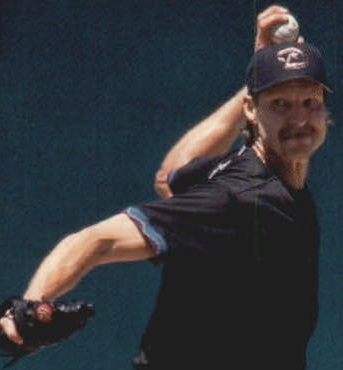
Cy Young Profile: Randy Johnson, 2000

Pitcher, Arizona Diamondbacks


Age:  37 (Sept. 10)
2nd season with Diamondbacks
Bats – Right, Throws – Left
Height: 6’10” Weight: 225

Prior to 2000:
A native of California, Johnson starred in baseball and basketball in high school. He received a scholarship to USC for both sports and was originally drafted as an amateur by the Braves in 1982, without signing a contract. Johnson spent three seasons playing college baseball and was drafted by Montreal in 1985, this time signing. With his great pitching speed, he moved up quickly through the minor league system, where he worked on his control. Johnson made his first major league appearance with the Expos late in the 1988 season and started four games, compiling a 3-0 record and 2.42 ERA with 25 strikeouts in 26 innings. Off to an 0-4 start in 1989, “The Big Unit” was traded to Seattle in May and went 7-9 in 22 starts with his new club and had a 4.40 ERA. In 1990, Johnson pitched the first no-hitter in franchise history against Detroit as part of a breakout season in which he compiled a 14-11 record with 3.65 ERA and continued to struggle with his control while leading the AL with 120 walks to go along with 194 strikeouts in 219.2 innings. He was also chosen to his first All-Star game. Continuing to improve, Johnson accumulated over 200 strikeouts for the first time in 1991 (228) and led the league for the first of four consecutive years with 241 in ’92 (the last of three straight seasons in which he topped the circuit in walks). He was again an All-Star in 1993, a year in which he compiled a 19-8 record and was 13-6 during the strike-abbreviated 1994 season. In 1995 the Mariners reached the postseason for the first time in franchise history and Johnson contributed mightily with an 18-2 record and AL-leading 294 strikeouts and 2.48 ERA. He received the AL Cy Young Award for his performance. In 1996 major back surgery limited “The Big Unit” to eight games, but he rebounded with a 20-4 record and 291 strikeouts in ’97. With talk of a trade swirling throughout the 1998 season, Johnson got off to a 9-10 record and 4.33 ERA before being dealt to the Houston Astros at the trade deadline. He helped his new club to a division title with a 10-1 record and 1.28 ERA. Entering the free agent market, Johnson signed a four-year contract worth $52 million with the second-year Diamondbacks in 1999. He had an excellent season for Arizona in ’99, posting a 17-9 record while leading the NL in ERA (2.48), strikeouts (364), innings pitched (271.2), and complete games (12), garnering another Cy Young Award. The team topped the NL West, although the Diamondbacks lost to the Mets in the NLDS.  

2000 Season Summary
Appeared in 35 games

[Bracketed numbers indicate NL rank in Top 20]

Pitching
Games – 35
Games Started – 35 [1, tied with four others]
Complete Games – 8 [1, tied with Curt Schilling]
Wins – 19 [3, tied with Greg Maddux]
Losses – 7
PCT - .731 [1]
Saves – 0
Shutouts – 3 [1, tied with Greg Maddux]
Innings Pitched – 248.2 [3]
Hits – 202
Runs – 89
Earned Runs – 73
Home Runs – 23
Bases on Balls – 76
Strikeouts – 347 [1]
ERA – 2.64 [2]
Hit Batters – 6
Balks – 2 [4, tied with sixteen others]
Wild Pitches – 5

League-leading win percentage was +.017 ahead of runner-up Shawn Estes
League-leading strikeouts were +130 ahead of runner-up Chan Ho Park

Midseason Snapshot: 14-2, ERA - 1.80, SO - 198 in 144.2 IP

---

Most strikeouts, game – 14 (in 7 IP) at Florida 9/10
10+ strikeout games – 23
Fewest hits allowed, game (min. 7 IP) – 3 (in 7 IP) vs. Milwaukee 5/26

Batting
PA – 92, AB – 83, R – 4, H – 13, 2B – 2, 3B – 0, HR – 0, RBI – 8, BB – 3, SO – 35, SB – 0, CS – 0, AVG - .157, GDP – 1, HBP – 1, SH – 5, SF – 0

Fielding
Chances – 30
Put Outs – 5
Assists – 22
Errors – 3
DP – 1
Pct. - .900

Awards & Honors:
NL Cy Young Award: BBWAA
All-Star (starting P for NL)
17th in NL MVP voting (5 points, 1% share)

NL Cy Young voting:
Randy Johnson, Ariz: 133 pts. – 22 of 32 first place votes, 83% share
Tom Glavine, Atl.: 64 pts. – 4 first place votes, 40% share
Greg Maddux, Atl: 59 pts. – 3 first place votes, 37% share
Robb Nen, SF: 20 pts. – 2 first place votes, 13% share
Darryl Kile, StL.: 8 pts. – 1 first place vote, 5% share
Kevin Brown, LAD: 4 pts. – 3% share

---

Diamondbacks went 85-77 to finish third in the NL Western Division, 12 games behind the division-winning San Francisco Giants. The pitching staff led the league in strikeouts (1220) and complete games (16).

Aftermath of 2000:
“The Big Unit” made it three straight Cy Young Awards in 2001, going 21-6 with a 2.49 ERA and 372 strikeouts. He created a productive tandem with RHP Curt Schilling, who had been acquired midway through the 2000 season, and Arizona went on to win the World Series, in which Johnson and Schilling were co-MVPs, with Johnson winning Game 7 in relief. Johnson was recipient of another Cy Young Award in 2002 following a 24-5 tally and 2.32 ERA with 334 strikeouts. The Diamondbacks fell short in the postseason but “The Big Unit” was re-signed. Knee surgery cut short his ’03 season and Johnson dropped to 6-8 with a 4.26 ERA.  Off to a 3-4 start at age 40 in 2004, Johnson pitched a perfect game against Atlanta. He went on to a 16-14 record and a 2.60 ERA and league-leading 290 strikeouts. Looking to shed salary in 2005, the Diamondbacks dealt Johnson to the New York Yankees where he won another 34 games over two seasons before returning to Arizona in 2007. Johnson spent 2007 and ’08 with the Diamondbacks before finishing out his career with San Francisco in 2009. For his major league career, Johnson appeared in 618 games, 603 of which were starts, and compiled 303 wins and 166 losses with a 3.29 ERA and 4875 strikeouts, the second highest total in MLB history to date. His record with Arizona alone was 118-62 with a 2.83 ERA and 2077 strikeouts.  He added another 14 wins in the postseason against 18 losses. He compiled five 300-strikeout seasons, was chosen to ten All-Star Games and won five Cy Young Awards (one in the AL and 4 in the NL with the Diamondbacks). Johnson was elected to the Baseball Hall of Fame in 2015. His #51 was retired by the Diamondbacks.

--


Cy Young Profiles feature pitchers who were recipients of the Cy Young Award by the Baseball Writers’ Association of America (1956 to present). The award was presented to a single major league winner from its inception through 1966 and from 1967 on to one recipient from each major league.

Nov 2, 2018

Cy Young Profile: Pedro Martinez, 1997

Pitcher, Montreal Expos


Age: 25
4th season with Expos
Bats – Right, Throws – Right
Height: 5’11” Weight: 170

Prior to 1997:
A native of the Dominican Republic who grew up in a town near Santo Domingo, Martinez followed his older brother Ramon, also a pitcher, in signing with the Los Angeles Dodgers at age 16 in 1988. He spent 1988 and ’89 with LA’s Dominican Summer League team, where he compiled an overall 12-3 record. At 18 in 1990 he was assigned to Great Falls of the Rookie-level Pioneer League, where Martinez started 14 games and compiled an 8-3 record with 82 strikeouts over 77 innings pitched. In 1991 he advanced from Class A Bakersfield to Class AA San Antonio and finally Class AAA Albuquerque and had an overall record of 18-8 with a 2.28 ERA and 192 strikeouts. He received Minor League Player of the Year recognition from The Sporting News for his performance.  The Dodgers returned Martinez to Albuquerque of the Pacific Coast League in 1992 where he went 7-6 with a 3.81 ERA and 124 strikeouts in 125.1 innings pitched. He received a September call-up to the Dodgers and went the distance in losing his first major league start to Cincinnati. He started the 1993 season with Albuquerque but was soon called up to the parent club where his first appearance was in relief of his brother Ramon. For the year Martinez pitched in 65 games, almost exclusively in relief, and posted a 10-5 record with a 2.61 ERA and 119 strikeouts over 107 innings.  After the season the Dodgers traded Martinez to the Montreal Expos for second baseman Delino DeShields. The Dodgers had questioned whether he had the size and stamina to succeed as a starting pitcher but he moved directly into Montreal’s rotation in 1994. The Expos had the best record in the NL when the season ended prematurely due to the players’ strike. Martinez, with his outstanding fastball and changeup, contributed an 11-5 tally with a 3.42 ERA and 142 strikeouts in 144.2 innings pitched. With his tendency to pitch high and inside he became known as a “headhunter” and hit a league-leading 11 batters and was ejected from 12 games and involved in three fights. The Expos lost several key players to free agency and were less competitive in 1995, although Martinez compiled a solid 14-10 record with a 3.51 ERA and 174 strikeouts. In a game against San Diego he became the second pitcher in major league history to take a perfect game into extra innings but lost it in the tenth inning and was relieved (Montreal still managed to win the game). The Expos finished second in the NL East in 1996, narrowly missing a Wild Card spot and Martinez was 13-10 with a 3.70 ERA and 222 strikeouts. He was selected as an All-Star for the first time.   

1997 Season Summary
Appeared in 35 games

[Bracketed numbers indicate NL rank in Top 20]

Pitching
Games – 31
Games Started – 31
Complete Games – 13 [1]
Wins – 17 [5, tied with Curt Schilling & Alex Fernandez]
Losses – 8
PCT - .680 [6]
Saves – 0
Shutouts – 4 [2, tied with Denny Neagle & Darryl Kile]
Innings Pitched – 241.1 [4]
Hits – 158
Runs – 65
Earned Runs – 51
Home Runs – 16
Bases on Balls – 67
Strikeouts – 305 [2]
ERA – 1.90 [1]
Hit Batters – 9 [12, tied with ten others]
Balks – 1
Wild Pitches – 3

League-leading complete games were +5 ahead of runner-up Carlos Perez
League-leading ERA was -0.30 lower than runner-up Greg Maddux

Midseason Snapshot: 10-4, ERA - 1.74, SO - 154 in 124 IP

---

Most strikeouts, game – 14 (in 9 IP) vs. Detroit 6/14
10+ strikeout games – 18
Fewest hits allowed, game (min. 7 IP) – 1 (in 9 IP) at Cincinnati 7/13

Batting
PA – 81, AB – 69, R – 5, H – 8, 2B – 2, 3B – 1, HR – 0, RBI – 0, BB – 3, SO – 28, SB – 0, CS – 0, AVG - .116, GDP – 2, HBP – 0, SH – 9, SF – 0

Fielding
Chances – 39
Put Outs – 7
Assists – 31
Errors – 1
DP – 1
Pct. - .974

Awards & Honors:
NL Cy Young Award: BBWAA
NL Pitcher of the Year: Sporting News
All-Star
16th in NL MVP voting, tied with Ray Lankford, StL. & Mark McGwire, StL. (6 points, 2% share)

NL Cy Young voting:
Pedro Martinez, Mon.: 134 pts. – 25 of 28 first place votes, 96% share
Greg Maddux, Atl.: 75 pts. – 3 first place, 54% share
Denny Neagle, Atl: 24 pts. – 17% share
Curt Schilling, Phila.: 12 pts. – 9% share
Darryl Kile, Hou.: 7 pts. – 5% share

---

Expos went 78-84 to finish fourth in the NL Eastern Division, 23 games behind the division-winning Atlanta Braves. The pitching staff led the league in complete games (27). The Expos were 11 games over .500 on July 1 but collapsed in the second half.

Aftermath of ‘97:
With one more year until he became a free agent, Martinez was traded by the Expos to the Boston Red Sox in the offseason. The Red Sox immediately signed him to a six-year contract extension, worth $75 million. He was 19-7 with his new club in 1998 with a 2.89 ERA and 251 strikeouts. He was an All-Star once again and finished second in AL Cy Young Award voting. He also saw his first postseason action as Boston placed second in the AL East and claimed the Wild Card slot. Martinez was even better in 1999 as he led the AL in wins (23, against 4 losses), ERA (2.07), and strikeouts (313). He won his second Cy Young Award and was also second in American League MVP voting. Boston again finished second and was a postseason Wild Card. Martinez won another Cy Young Award in 2000 with an 18-6 record, and a league-leading 1.74 ERA, 284 strikeouts, and 4 shutouts. The Red Sox once again ended up second in the AL East but did not qualify for the postseason. Martinez was sidelined with a minor rotator cuff tear in 2001 which limited him to 18 starts and a 7-3 record. He came back with a 20-4 record in 2002 and led the AL in ERA (2.26) and strikeouts (239), and he finished second in the league’s Cy Young Award voting. Martinez topped the AL in ERA again in 2003 with a 2.22 mark to go with his 14-4 record and 206 strikeouts. Boston made the postseason as a Wild Card entry and reached the ALCS vs. the arch-rival Yankees, where Martinez became involved in some controversy. During his Game 3 start and having struck a batter and blown a lead he became involved in a shouting match with members of New York’s dugout. When Yankee RHP Roger Clemens threw at Boston LF Manny Ramirez, the benches cleared and 72-year-old Yankee coach Don Zimmer ran at Ramirez, who tossed him to the ground. In Game 7, he pitched into trouble and convinced manager Grady Little to leave him in the game, leading to four successive hits and a tie score that was decided in favor of the Yanks in extra innings. In 2004 Martinez contributed a 16-9 record to Boston’s season that culminated in a World Series victory for the first time since 1918. His 3.90 ERA was far less impressive than usual but he went 2-1 in the postseason including a win in the World Series. As a free agent in the offseason Martinez signed a four-year, $53 million contract with the  New York Mets. He posted a 15-8 record in 2005 with a 2.82 ERA and 208 strikeouts. He was an All-Star selection for the third-place Mets as well. He was an All-Star once again in 2006, although he suffered through an injury-riddled season that limited him to a 9-8 record with a 4.48 ERA before a torn rotator cuff that required surgery ended his season, keeping him out of New York’s postseason run. The recovery from the surgery was lengthy and appeared to diminish his fastball. He appeared in five games late in the 2007 season and was 3-1 with a 2.57 ERA. Martinez had a dreadful year in 2008, going 5-6 with a 5.61 ERA. He was an unwanted free agent in apparent decline who finally signed with the Philadelphia Phillies midway through the 2009 season. He had a 5-1 record with a 3.63 ERA for the NL East champions in what was his final season. Overall in the major leagues Martinez compiled a 219-100 record with a 2.93 ERA and 3154 strikeouts in 2827.1 innings pitched. He was 55-33 with a 3.06 ERA and 843 strikeouts for Montreal. In the postseason he had a 6-4 tally with a 3.46 ERA and 96 strikeouts. He was an eight-time All-Star and won three Cy Young Awards.  He was elected to the Baseball Hall of Fame in 2015. He was inducted into the Canadian Baseball Hall of Fame in 2018. The Red Sox retired his #45.

--


Cy Young Profiles feature pitchers who were recipients of the Cy Young Award by the Baseball Writers’ Association of America (1956 to present). The award was presented to a single major league winner from its inception through 1966 and from 1967 on to one recipient from each major league.

Oct 29, 2018

Rookie of the Year: Alfredo Griffin, 1979

Shortstop, Toronto Blue Jays


Age:  21
Bats – Both, Throws – Right
Height: 5’11” Weight: 160

Prior to 1979:
A native of the Dominican Republic, Griffin was signed by the Cleveland Indians in 1973 at age 16. In 1974, playing for two teams at the Rookie and Class A levels, he batted a combined .259 and stole 10 bases. Moving on to San Jose of the Class A California League in 1975, the 17-year-old hit only .229 with 82 hits in 124 games, but performed well in the field. Griffin jumped from Class A through AA to AAA in 1976, impressing with his range at shortstop but exhibiting his best hitting in the Class AA Eastern League where he batted .275 in 58 games for the Williamsport Tomahawks. He earned a September call-up to the Indians where he appeared in 12 games and produced his first major league hit. Griffin spent 1977 in the Class AAA International League with the Toledo Mud Hens where he learned to switch-hit and batted .249 and drew 35 walks for a .305 on-base percentage while stealing 26 bases. He received another late-season call-up to the Indians and hit .146 in 14 games. Griffin was farmed out to the Portland Beavers of the Class AAA Pacific Coast League in 1978, where his batting average jumped to .291 with 22 doubles, 10 triples, and 5 home runs. He stole 35 bases (but was caught 18 times). In one last late-season call-up to Cleveland, Griffin appeared in five games and produced two hits. In the offseason he was traded to the Blue Jays with one other minor league prospect for right-handed relief pitcher Victor Cruz. Still a major league rookie, Griffin became the starting shortstop for Toronto in ’79.     

1979 Season Summary
Appeared in 153 games
SS – 153

[Bracketed numbers indicate AL rank in Top 20]

Batting
Plate Appearances – 689 [8]
At Bats – 624 [7]
Runs – 81
Hits – 179 [11, tied with Eddie Murray]
Doubles – 22
Triples – 10 [5, tied with Darrell Porter & Ron LeFlore]
Home Runs – 2
RBI – 31
Bases on Balls – 40
Int. BB – 0
Strikeouts – 59
Stolen Bases – 21 [16]
Caught Stealing – 16 [2, tied with Mitchell Page]
Average - .287
OBP - .333
Slugging Pct. - .364
Total Bases – 227
GDP – 10
Hit by Pitches – 5 [13, tied with nine others]
Sac Hits – 16 [4]
Sac Flies – 4

Midseason snapshot: HR - 0, RBI - 14, R – 46, AVG. - .255, OBP – .316

---

Most hits, game – 4 (in 6 AB) vs. Baltimore 5/18 – 11 innings, (in 6 AB) vs. Oakland 6/17, (in 5 AB) at Kansas City 7/31
Longest hitting streak – 14 games
Most HR, game – 1 (in 4 AB) vs. Oakland 8/28, (in 4 AB) vs. Oakland 8/29
HR at home – 2
HR on road – 0
Multi-HR games – 0
Most RBIs, game – 2 on five occasions
Pinch-hitting – No appearances

Fielding
Chances – 809
Put Outs – 272
Assists – 501
Errors – 36
DP – 124
Pct. - .956

Awards & Honors:
AL Rookie of the Year: BBWAA (co-winner)

AL ROY Voting:
Alfredo Griffin, Tor.: 7 of 28 votes, 25% share
John Castino, Min..: 7 votes, 25% share
Mark Clear, Cal.: 5 votes, 18% share
Ross Baumgarten, ChiWS.: 3 votes, 11% share
Ron Davis, NYY: 3 votes, 11% share
Pat Putnam, Tex.: 3 votes, 11% share

---

Blue Jays went 53-109 to finish seventh in the AL Eastern Division, 50.5 games behind the division-winning Baltimore Orioles.

Aftermath of ‘79:
Griffin followed up in 1980 by batting .254, leading the AL with 15 triples, and teaming well with second baseman Damaso Garcia, although his error total of 37 was still high, and while he stole 18 bases he was caught stealing 23 times. His performance at bat tailed off badly in the strike-interrupted 1981 season, and Griffin hit just .209. He also committed 31 errors in the field, the most of any AL shortstop. His overall performance improved in 1982 as he played in all 162 games and batted .241 and was steadier in the field. Griffin appeared in 162 games again in 1983 and hit .250 with 9 triples and in 1984 he played some second base and split time at short with the up-and-coming Tony Fernandez, ending up with a .241 average and an idiosyncratic All-Star selection. In the offseason he was traded to Oakland with outfielder Dave Collins for reliever Bill Caudill. Griffin had a fine first season with the A’s in 1985, hitting .270, stealing 24 bases, and receiving a Gold Glove for his defensive play. He followed up in 1986 by playing through a variety of ailments to post a .285 batting average and 33 stolen bases and remaining steady in the field. He hit .263 in 1987 and suffered a late-season thumb injury that had him yielding his starting shortstop job to talented rookie Walt Weiss. In the offseason he was part of a big three-team trade that landed him with the Los Angeles Dodgers. Griffin suffered through a miserable 1988 season with LA, missing two months due to a broken hand and hitting just .199 for the year. He came back in 1989 by playing in 136 games and batting .247. Griffin remained with the Dodgers until 1991, after which he returned to Toronto as a free agent. He saw action at shortstop and second and third base in his final two major league seasons which were both capped by World Series victories.  Overall for his major league career, Griffin batted .249, with 1688 hits that included 245 doubles, 78 triples, and 24 home runs. He compiled 527 RBIs and 192 stolen bases and was a one-time All-Star and Gold Glove recipient. With Toronto he hit .249 with 844 hits that included 127 doubles, 50 triples, and 13 home runs while he accumulated 231 RBIs and 79 stolen bases. Griffin went on to become a long-time coach with the Blue Jays and Angels.     

--


Rookie of the Year Profiles feature players who were recipients of the Rookie of the Year Award by the Baseball Writers’ Association of America (1947 to present). The award was presented to a single major league winner from its inception through 1948 and from 1949 on to one recipient from each major league. 

Oct 25, 2018

MVP Profile: Juan Gonzalez, 1996

Outfielder, Texas Rangers


Age:  26
7th season with Rangers
Bats – Right, Throws – Right
Height: 6’3”    Weight: 175

Prior to 1996:
A native of Puerto Rico, the lanky Gonzalez drew attention while playing youth baseball and signed with the Rangers as a 16-year-old in 1986. He appeared in 60 games that year in the Rookie-level Gulf Coast League and hit .240. Gonzalez moved on to Gastonia of the Class A South Atlantic League in 1987 where he produced 21 doubles, 14 home runs, and 74 RBIs with a .265 batting average over the course of 127 games. In 1988 he was with Port Charlotte of the Class A Florida State League and hit .256 with 8 home runs and 43 RBIs in 77 games. Gonzalez moved up to the Tulsa Drillers of the Class AA Texas League in 1989 where he improved to .293 with 30 doubles, 21 home runs, and 85 RBIs while leading the league with 254 total bases. He was named to the Texas League All-Star team for his performance. He also received a late-season call-up to the Rangers where he batted only .150 in 24 games but hit his first major league home run. Gonzalez was with the Oklahoma City 89ers of the Class AAA American Association in 1990, where he hit .258 with 29 home runs and 101 RBIs (the home run and RBI totals led the league). Named MVP of the American Association, Gonzalez received another call-up to the Rangers and batted .289 with 4 home runs and 12 RBIs in 25 games. Sticking with Texas in 1991, despite struggling with a back injury, he split his time between center and left fields and hit .264 with 27 home runs and 102 RBIs. A line-drive hitter with power, Gonzalez, regularly playing center field in 1992, led the AL with 43 home runs and also compiled 109 RBIs and batted .260. “Juan-Gone” topped the league in home runs once again in 1993 with 46 to go along with 118 RBIs and a .310 batting average while also leading the AL with a .632 slugging percentage. He was an All-Star for the first time and placed fourth in league MVP balloting. In the strike-shortened 1994 season, while adjusting to The Ballpark in Arlington, Gonzalez dropped to 19 home runs and 85 RBIs with a .275 average. In an injury-plagued 1995 season, he appeared in 90 games, primarily as a Designated Hitter, and slugged 27 home runs with 82 RBIs and a .295 average. In 1996 he was utilized in right field, his natural position, although he was not an exceptional fielder.   

1996 Season Summary
Appeared in 134 games
RF – 102, DH – 32

[Bracketed numbers indicate AL rank in Top 20]

Batting
Plate Appearances – 592
At Bats – 541
Runs – 89
Hits – 170
Doubles – 33
Triples – 2
Home Runs – 47 [5]
RBI – 144 [2]
Bases on Balls – 45
Int. BB – 12 [6, tied with four others]
Strikeouts – 82
Stolen Bases – 2
Caught Stealing – 0
Average - .314 [14, tied with Derek Jeter]
OBP - .368
Slugging Pct. - .643 [2]
Total Bases – 348 [5]
GDP – 10
Hit by Pitches – 3
Sac Hits – 0
Sac Flies – 3

Midseason snapshot: HR – 22, RBI - 70, AVG - .320, SLG PCT – .652

---

Most hits, game – 5 (in 5 AB) vs. NY Yankees 7/30
Longest hitting streak – 21 games
HR at home – 17
HR on road – 19
Most home runs, game – 2 on five occasions
Multi-home run games – 5
Most RBIs, game – 6 vs. Baltimore 4/19
Pinch-hitting – No appearances

Fielding
Chances – 171
Put Outs – 163
Assists – 6
Errors – 2
DP – 0
Pct. - .988

Postseason: 4 G (ALDS vs. NY Yankees)
PA – 19, AB – 16, R – 5, H – 7, 2B – 0, 3B – 0, HR – 5, RBI – 9, BB – 3, IBB – 1, SO – 2, SB – 0, CS – 0, AVG - .438, OBP - .526, SLG - 1.375, TB – 22, GDP – 0, HBP – 0, SH – 0, SF – 0

Awards & Honors:
AL MVP: BBWAA
Silver Slugger

Top 5 in AL MVP Voting:
Juan Gonzalez, Tex.: 290 pts. - 11 of 28 first place votes, 74% share
Alex Rodriguez, Sea.: 287 pts. – 10 first place votes, 73% share
Albert Belle, Clev.: 228 pts. – 2 first place votes, 58% share
Ken Griffey Jr, Sea.: 188 pts. – 4 first place votes, 48% share
Mo Vaughn, Bos.: 132 pts. – 34% share
(1 first place vote for Ivan Rodriguez, Tex. who ranked tenth)

Rangers went 90-72 to finish first in the AL Western Division by 4.5 games over the Seattle Mariners, the first division title in franchise history. Lost ALDS to the New York Yankees, 3 games to 1, despite Gonzalez's batting heroics.  

Aftermath of ’96:
Gonzalez missed the first 24 games of the 1997 season due to a thumb injury but still had another strong year at bat by hitting 42 home runs with 131 RBIs and a .296 average. That set the stage for another MVP season in 1998 as he batted .318 with 45 home runs, and a league-leading 50 doubles and 157 RBIs. The numbers dropped to 39 home runs with 128 RBIs and a .326 average in 1999, following which he was traded to the Detroit Tigers as part of a nine-player deal. Bothered by a foot injury and playing home games at spacious Comerica Park, Gonzalez had a down year in 2000, hitting just 22 home runs with 67 RBIs and a .289 average. He still received a one-year, $10 million contract to join the Cleveland Indians in 2001. He hit .325 with 35 home runs and 140 RBIs and was voted to the All-Star Game as well as placing fifth in league MVP balloting and receiving a Silver Slugger. In the offseason he signed a two-year, $24 million contract to return to the Rangers. Gonzalez suffered through an injury plagued 2002 season in which he was limited to 70 games and hit just 8 home runs and his 2003 season was cut short by a leg injury that held him to 24 home runs and 70 RBIs in 82 games. Moving on to the Kansas City Royals as a free agent in 2004, Gonzalez played in 33 games due to a bad back and ended up with a mere 5 home runs and 17 RBIs. He signed with Cleveland in 2005 but appeared in only one game. Thus ended his major league career, despite getting a feeler from the St. Louis Cardinals to attempt a comeback in 2008. He did play in 36 games for the Long Island Ducks of the independent Atlantic League in 2006, hitting 6 home runs and batting .323. Overall for his major league career Gonzalez batted .295 with 1936 hits that included 388 doubles, 25 triples, and 434 home runs. He also compiled 1404 RBIs. With Texas he batted .293 with 320 doubles, 21 triples, and 372 home runs, and knocked in 1180 runs as well. He was a three-time All-Star as well as two-time AL MVP and six-time Silver Slugger Award recipient. Gonzalez was elected to the Texas Rangers Hall of Fame in 2015, but his legacy has been clouded by allegations of steroid use during his career.   

--


MVP Profiles feature players in the National or American leagues who were winners of the Chalmers Award (1911-14), League Award (1922-29), or Baseball Writers’ Association of America Award (1931 to present) as Most Valuable Player.